




digital memory work
More and more writing technologies incorporate database or database-like aspects, making them explicitly oriented toward memory work. In 2004, I began a study designed to explore how writers were using these new writing tools and to identify the software's effects on memory work and writing more generally.
I selected research participants that had just begun using new software, because their reasons for choosing the software would be fresh in the minds, and they would still be in the process of integrating it with their other writing tools and habits. Writers who have used software long enough to become skilled with it often have a hard time remembering what their early experiences were like, and may recast their initial motivation for adopting the program in light of their current use. Additionally, I chose participants willing to be interviewed over the course of several years, so I could track the changes in their use over time.
Several participants had begun using a new component of Microsoft Office called OneNote. Instead of creating discrete documents, OneNote stores text, images, sound, and video within a singular data space designed to appear like a notebook subdivided with section tabs across the top of the screen, and page tabs across the right side.
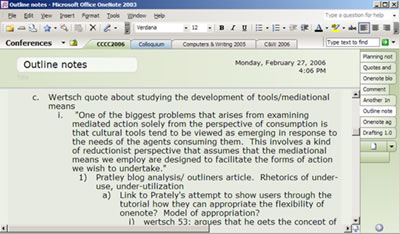
screen capture of a page from my OneNote notebook
My research interest in OneNote stemmed from its search function, and my suspicion that searching through dense hierarchies of notes from disparate projects would significantly alter writers' memory work, creating chances for serendipitous discovery of connections between notes and ideas. As it turns out, the participants in my study rarely used the search, and made much more use of the visual tabs and hierarchy to organize and direct their planning and thinking while writing. In a recent article from Kairos, I describe one writer's use of these tabs in terms of distributed cognition, where the coordination of tools becomes a primary focus. Configured as active participants in distributed cognition approaches, tools shape and direct activity along with the people using them.
Additionally, many research participants had just begun using, or just stopped using, Thomson's EndNote, a bibliography database and formatting program. One of the main issues that arose in interviews was EndNote's process of inserting in-text citations in order to automatically produce formatted works cited pages. Writers in my study struggled against the process of calling up the citation dialog box to toggle options and type in page numbers, finding it disruptive to their writing. Although they said that automated citation management appealed to them, many abandoned this feature.
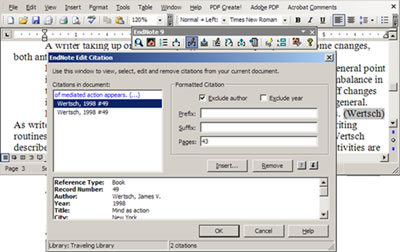
EndNote screenshot
From this study, I unfortunately didn't discover whether memory work with digital tools represents a drastic break from analog memory practices. Instead, the interviews I conducted speak more to the strategies writers use to adopt new tools, and the ways writers understand the participation of their tools in their writing processes. From these interviews I have been able to begin constructing a heuristic that addresses the successful adoption of new technology, a crucial aspect of writing with computers.